Players Similar To: turn 800 hands on a villain into millions
You rarely have enough hands on one opponent to know how he plays a specific river spot. Players Similar To builds a population of players who play like him - so you can study his tendencies on a real sample.
The small-sample problem
A HUD with 800 hands tells you a villain's VPIP and PFR. It does not tell you how often he bluffs a turn probe after the flop checks through - you might have seen that spot twice. With mass data analysis you can borrow the sample from players who play like him.
How Players Similar To works
- Pick any player from the database.
- Choose which stats must match: preflop (VPIP, PFR, limp, open, call open, 3bet, fold to 3bet, 4bet), blind battles, and postflop (AFq, cbet and fold to cbet on the flop, turn and river, EV winrate).
- Set how closely each stat must match - exact, close or wide, or your own lower and higher end with sliders. You can even move the target value to model a slightly different player.
- Poker MDA builds the population and you analyze it with all the usual filters, lines, bet sizes and showdown ranges.
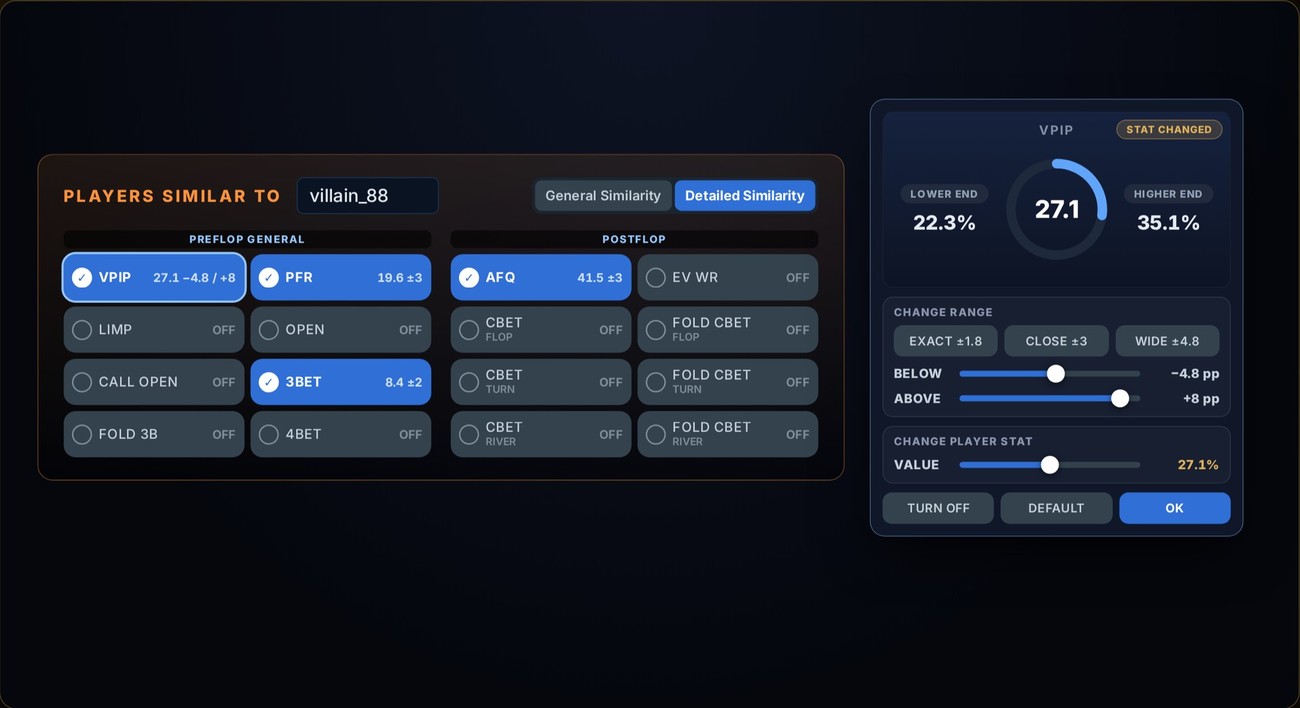
General or detailed similarity
General Similarity picks the stats for you with one setting per area (stakes, preflop, postflop: very close, close or loose). Detailed Similarity lets you control every stat yourself.
When to use it
- Preparing for a regular you play a lot against, but have few hands on in rare spots.
- Studying a player type - for example aggressive fish at NL50 - with a precise statistical profile.
- Checking whether a read on one player holds up on a large sample of similar players.
More about the method in the Poker MDA guide and Poker MDA vs GTO.
Try it on your toughest opponent. Players Similar To is part of the paid plans; the free version lets you explore the tool first. Open Poker MDA