Poker MDA vs GTO: why you need both
GTO is the strategy that cannot be exploited. Mass data analysis shows how real players actually play. The money is made in the gap between the two.
What GTO gives you
A solver finds an equilibrium strategy: frequencies and sizes that cannot be exploited by any opponent. It is the perfect baseline - but it assumes your opponent also plays perfectly. Real players don't.
What poker MDA gives you
Poker MDA looks at what the population really does in a spot: how often it folds, calls, bets or raises, which sizes it uses and which hands it shows down. It is built on 245M+ NLH cash hands from GGPoker, PokerStars, iPoker and 888poker.
The gap is the exploit
Where the population folds more than GTO, bluffs gain value. Where it calls more, thin value bets gain value. Where a line is almost never a bluff in practice, folding becomes correct even when the solver says call.
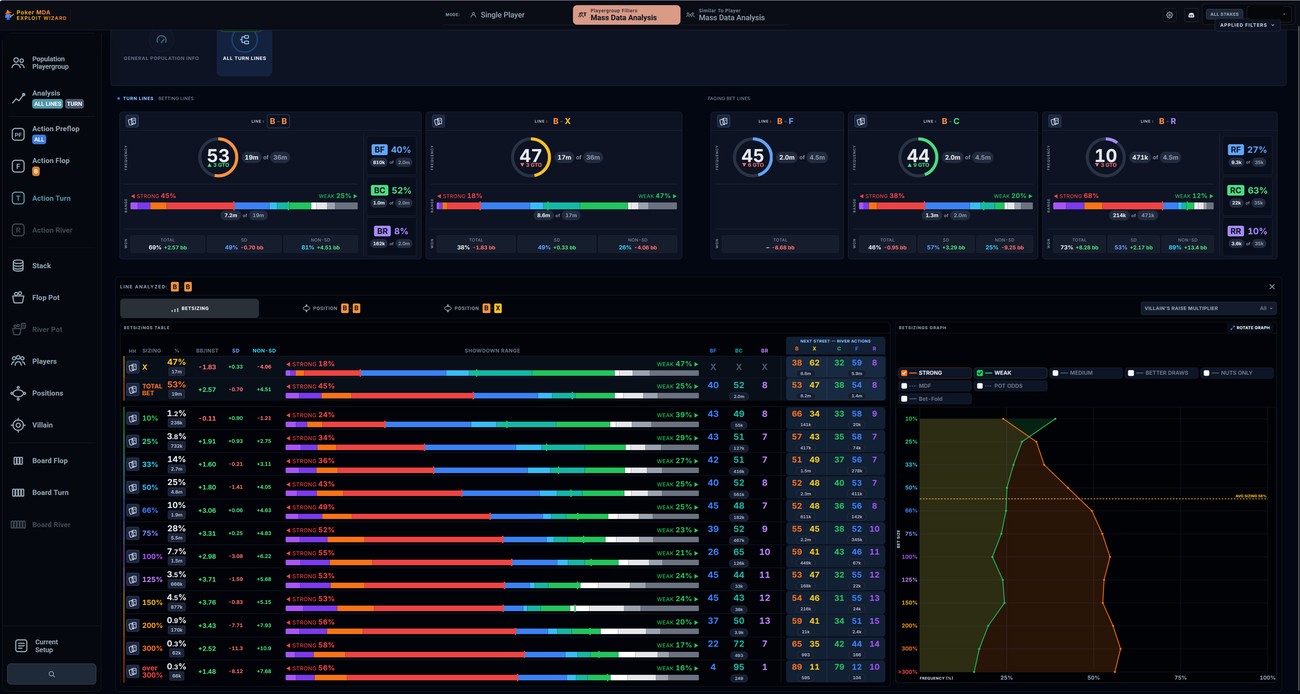
In Poker MDA you see this gap directly: the vast majority of frequencies come with a GTO reference, and on almost every postflop line the ▲/▼ number shows how far the chosen players - a whole pool segment or a single villain - are from GTO.
Preflop: ranges side by side with GTO
Preflop you can compare the population's ranges with GTO frequencies, position by position, and see which spots it overfolds or overdefends.
How to combine MDA and GTO
- Start from the GTO baseline for the spot.
- Check the population frequencies and showdown ranges in Poker MDA for your stakes and room.
- Adjust where the gap is big and the sample is large: bluff more where they overfold, value bet thinner where they overcall, fold more where they underbluff.
- Go back to the hand histories to confirm what kind of hands drive the numbers.
New to MDA? Start with the Poker MDA guide.