Poker MDA: what mass data analysis is and how to use it
Poker MDA (mass data analysis) means studying how a whole population of players plays a spot - not one opponent, but thousands of them at once. This guide explains what MDA is, why it works and how to use it in NLH cash games.
What is MDA in poker?
Mass data analysis takes a huge database of hands played by many different players and aggregates them. Instead of asking "what does this one villain do?", you ask "what does the typical NL50 player on GGPoker do when he check-calls the flop and the turn pairs the board?". With enough hands, the answer is not a guess - it is a frequency.
Poker MDA is built on 245M+ NLH cash game hands and 790K+ players from GGPoker, PokerStars, iPoker and 888poker, from NL10 up to NL2000+.
Why population data matters
Most of your opponents are unknowns or players you have a small sample on. Against them, the best default is not a theoretical strategy but the way the population really plays. MDA shows you exactly that:
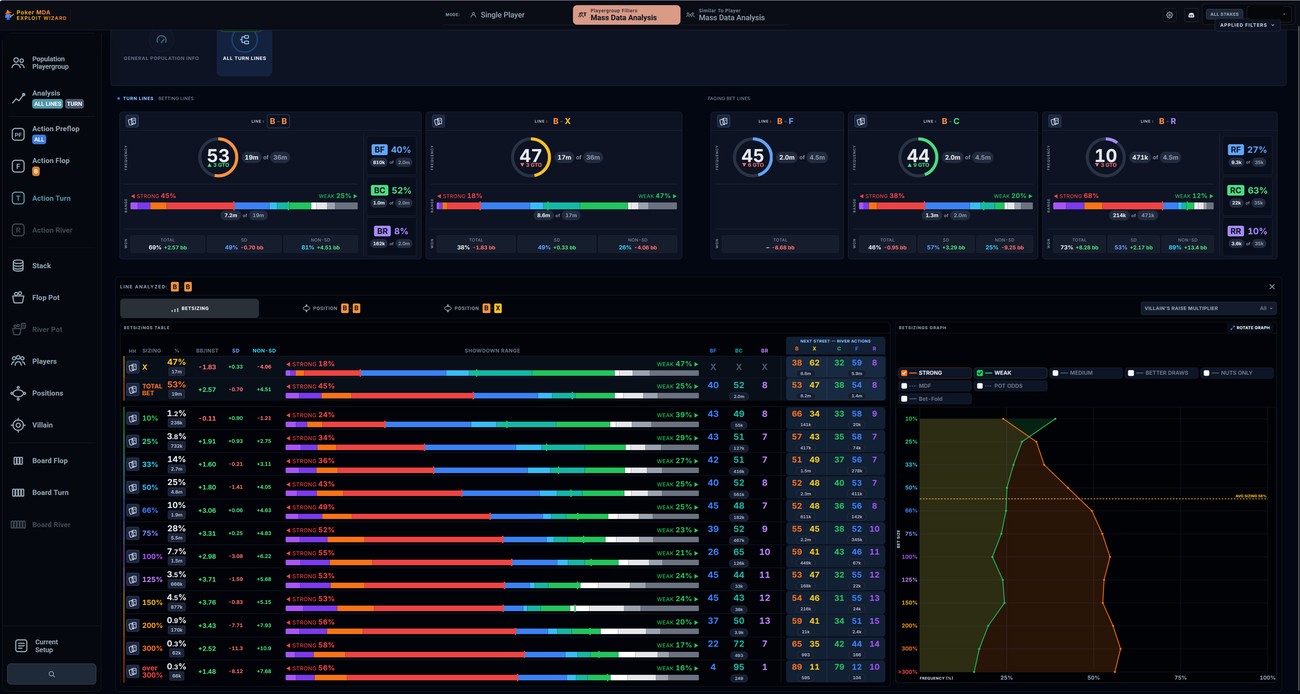
- Frequencies - how often the pool folds, calls, bets or raises in a given spot.
- Bet sizing - which sizes it uses and what each size means.
- Showdown ranges - which hands players actually show up with for each line and each size.
- Next street - what happens after each sizing on the next street.
How to use poker MDA, step by step
1. Choose the population
Filter the player pool by room, stakes, player type, aggression and calling tendencies - or analyze one specific player. You can also use Players Similar To to build a population of players who play like one opponent.
2. Choose the spot
Narrow it down with 25+ filters that combine with each other: actions on every street, bet sizes, starting pot on the flop and river, effective stack, positions (IP/OOP), number of players, villain type and board texture on the flop, turn and river.
3. Read the results
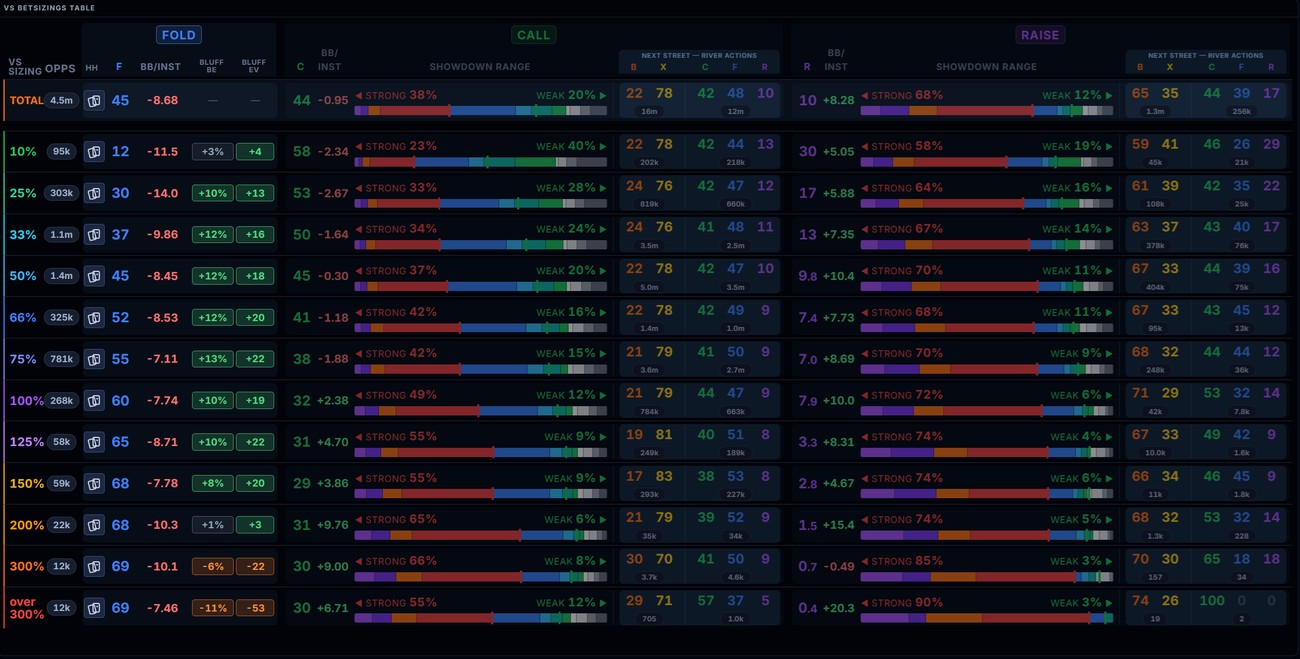
Look at all lines of a street on one screen, or open one exact line. For every bet size you see the frequency, the showdown range split into 12 hand categories and the actions on the next street.
4. Check the hands
Every number is backed by real hand histories. Open them to see exactly which hands and boards are behind a frequency.
Typical exploits you find with MDA
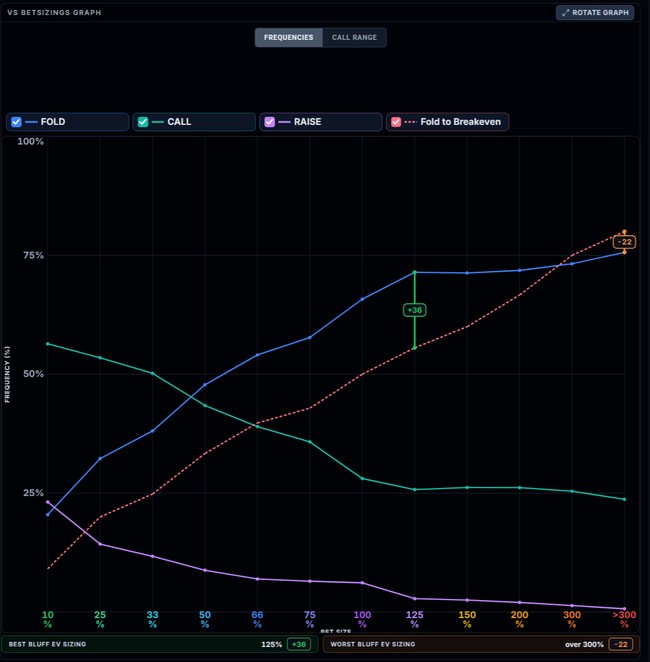
- Spots where the pool folds too much to a specific bet size - and which size gives the best bluff EV.
- Lines where the pool is almost never bluffing, so folding marginal hands is profitable.
- Bet sizes that are heavily polarized (or heavily merged) at a given stake.
- Differences between stakes and rooms - what works at NL50 may not work at NL500.
MDA and GTO
MDA does not replace GTO - it tells you where real players deviate from it. Read more in Poker MDA vs GTO.